
Big Bear Lake Home Not Selling in 2026? Here's What 134 Days on Market Means — and What to Do Next
Should You Reduce Your Price Now — or Wait Another 30 Days?
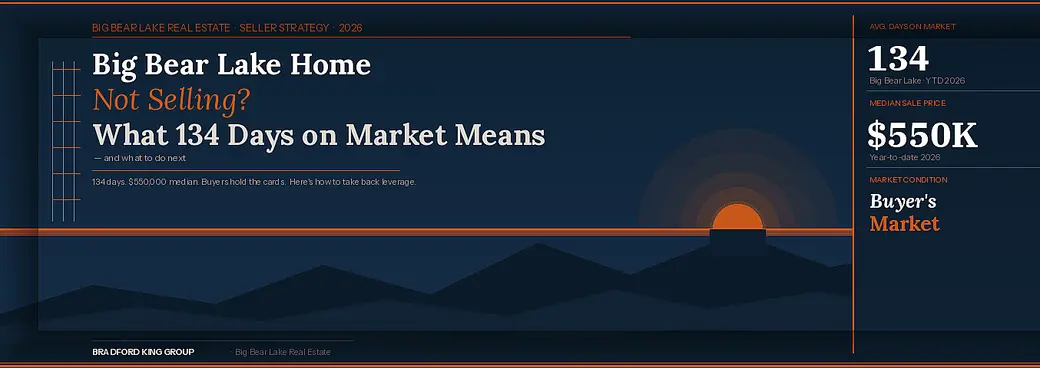
In Big Bear Lake's current market, homes are averaging 134 days to sell. Waiting another 30 days rarely improves your position — it typically weakens it. If your listing isn't generating strong activity in the first 2–3 weeks, the market is already signaling misalignment.
How the Big Bear Lake Market Works Right Now
Big Bear Lake is not a suburban housing market. Demand here is driven by second-home buyers, short-term rental investors, and Southern California families seeking mountain escapes — making it highly seasonal and responsive to pricing precision in ways that traditional residential markets are not.
Here's where the market stands in 2026:
- Median sale price: $550,000 year-to-date
- Average days on market: 134 days — well over 100 days for most listings
- Inventory is up significantly year-over-year, giving buyers more choices and more leverage
- This is a buyer's market. Multiple offers are rare; well-priced homes still move efficiently
The takeaway: buyers have options and they know it. Overpriced listings sit. Competitively positioned homes still attract serious attention.
The Critical First 14–21 Days
When your property hits the MLS, it enters its highest-visibility window. Active buyers see it immediately. Local agents match it to pre-qualified clients. STR investors run their rental income projections. Second-home buyers schedule weekend showings.
If strong activity doesn't materialize in this window, buyer psychology begins to shift. Instead of urgency, buyers start asking:
- "Why hasn't this sold yet?"
- "Is there something wrong with it?"
- "How low will they go?"
In a resort market like Big Bear, momentum is everything. Once a listing develops a "stale" perception, it becomes significantly harder — and more expensive — to recover.
What Really Happens When You "Give It More Time"
Sellers often believe patience signals strength. But here's what consistently happens in Big Bear Lake when listings sit:
- Showing volume drops. With inventory up significantly, fresh competition arrives constantly and pushes aging listings down buyers' priority lists.
- Low offers replace serious ones. Once buyers perceive a motivated seller, they negotiate aggressively. You end up with the reduction anyway — just with less leverage.
- New listings steal attention. A freshly-listed, competitively-priced home in your neighborhood immediately absorbs buyers who would have toured yours.
- Seasonal windows close. Big Bear has real seasonality. Missing a spring or summer demand window because of an overpriced listing can push you into a slower fall or winter cycle.
How to Know If You Actually Need a Price Reduction
Not every stalled listing is a pricing problem — but the signals are usually clear. Ask yourself these four questions:
- Showings but no offers? Buyers like the property but not at this price.
- Sparse or no showings? You may be priced outside the active search range. Buyers are filtering you out before they ever visit.
- A better-positioned home just listed nearby? Buyers make decisions relative to current competition — not historical sales.
- Priced based on a peak-season sale? Big Bear pricing fluctuates seasonally. What sold at peak last summer doesn't always translate to today's buyer.
If two or more apply, the issue almost certainly isn't marketing exposure — it's market positioning.
The Real Cost of Waiting Too Long
- Larger cumulative price cuts than an early, targeted adjustment would have required
- Appraisal challenges once you're under contract — if the market shifted while you waited, the appraised value may not support your eventual price
- Buyers requesting repair credits and concessions when they sense a motivated seller
- A final sales price lower than what a well-timed, strategic reduction would have achieved
Momentum creates leverage. Staleness creates concessions. The longer a listing sits, the more the buyer holds the cards.
How to Reduce Price the Right Way
A price reduction should never feel reactive. When done correctly, a strategic adjustment:
- Moves you into a new buyer search price bracket, expanding your audience
- Accounts for the current absorption rate in your specific neighborhood and price band
- Factors in STR income potential and how investor-buyers evaluate rental yield in Big Bear
- Is paired with renewed marketing — fresh photography, updated listing copy, social push, and direct agent outreach
- Resets buyer urgency by making your home feel new to market again
A $10,000 reduction that doesn't move you into a new search bracket accomplishes almost nothing. A properly engineered adjustment — one that places you at or just below a key psychological price threshold — can restart competition even in a buyer's market.
Big Bear-Specific Factors That Affect Your Pricing
Big Bear buyers evaluate properties on factors beyond square footage and bedroom count. Your pricing must account for:
- STR eligibility and permit status under current San Bernardino County and city regulations
- Insurance sensitivity — fire zone ratings and homeowner's insurance costs are increasingly factored into buyer offers
- Neighborhood micro-demand (some pockets outperform others significantly)
- Lake proximity, mountain views, and ski resort access — these are not interchangeable features
If your list price doesn't reflect how today's buyers weigh these factors, the market will correct you. The question is only whether you correct proactively or reactively.
Frequently Asked Questions
Get a Straight Answer About Your Listing
We'll evaluate your property's exact positioning in today's Big Bear Lake real estate market — real-time showing data, active competitive inventory, absorption rates, and seasonal demand shifts — and give you a clear picture of your options. No pressure. No blanket advice. Just clarity.
Categories
Recent Posts