
How to Price Your Big Bear Lake Cabin to Sell | Bradford King Group
Seller Strategy · Big Bear Lake, CA · February 2026
How to Price Your Big Bear Lake Cabin to Actually Sell in This Market
A step-by-step pricing strategy from Bradford King Group — your local Big Bear Lake realtor
You've been watching your Big Bear Lake cabin sit on the market. Maybe it's been 60 days. Maybe 130. The showings have slowed, and the offers just aren't coming. Sound familiar?
Here's the reality: in today's Big Bear Lake real estate market, overpricing isn't just an inconvenience — it's a deal-killer. Buyers have more choices, more time, and more leverage than they've had in years. And the cabins that are selling? They're priced with surgical precision.
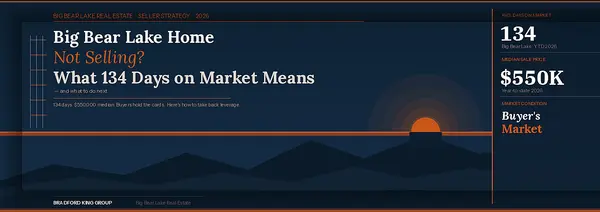
This guide gives you the exact pricing framework we use at Bradford King Group to move Big Bear Lake properties in 45–60 days — even in a buyer's market with 130+ average days on market.
What the Big Bear Lake Market Is Actually Telling Sellers Right Now
Before you price anything, you need to understand the landscape. Here's what current market data shows as of February 2026:
- Days on Market: Big Bear Lake cabins are averaging 130+ days on market across active listings. Well-priced cabins with current local comp support can still close in 45–60 days — but that requires a local agent with current data, not an automated estimate.
- Price Reductions: Sellers are seeing 3–10% cuts from original list prices — concentrated in listings that launched too high or have been sitting 90+ days without strategic adjustment.
- Buyer Pool: Second-home buyers and investment property buyers are both rate-sensitive and actively re-engaging as mortgage rates ease. The buyer wave is building now, ahead of summer competition.
- Inventory: More active listings than closings, but absorption is beginning to improve as buyer confidence builds with improving rates. Big Bear Lake is officially a buyer's market — which means pricing discipline is non-negotiable.
- The Opportunity: The pre-spring window has lower competing inventory and motivated, rate-triggered buyers who are searching right now — before the summer listing surge hits.
"The sellers who priced strategically in this market are going under contract. The ones who tested the high end are still waiting at 130+ days."Bradford King Group · Big Bear Lake
The Rate Shift That Changes Everything for Big Bear Lake Sellers
Here's the single biggest development affecting Big Bear Lake sellers right now: mortgage rates have eased to the high 5s to low 6s. For second-home buyers and investment property buyers — the two groups who drive this market — the difference between 7.5% and 5.9% is enormous.
One important nuance: while national headline rates may be in the high 5s, second homes and investment properties typically carry a rate premium of 0.5%–1.0% above primary residence rates. That means your buyers are likely seeing rates in the 6.25%–6.75% range — still meaningfully better than the 7.5%+ environment that shut many of them out, but worth keeping in mind when evaluating buyer purchase power.
Buyers who were priced out at 7%+ are actively re-entering the market. The rate improvement meaningfully improves monthly payment math for second-home buyers (hundreds of dollars per month on a $600K cabin), and improves debt-service coverage ratios for investment buyers enough to make Big Bear Lake properties financially viable again. Even at 6.5%, these buyers are far better positioned than they were at 7.5%+. This wave is building before the spring listing surge — sellers who price correctly now capture it with less competition.
This is why waiting for summer is often a mistake. The buyers responding to improved rates are searching now — not in June. And by summer, you'll be competing against a flood of other sellers who had the same "wait" instinct.
Why Most Big Bear Lake Cabin Sellers Price Wrong
The three most common pricing mistakes we see as your Big Bear Lake realtor:
1. Pricing to What You Paid — or What You Need
The market doesn't care what you paid in 2021 at peak COVID pricing, or what you need to net to pay off the mortgage. Buyers are comparing your cabin against everything else available right now — and they'll walk if you're out of line.
2. Using the Wrong Comps
Big Bear Lake is a hyper-local market. A 3-bedroom in Moonridge prices differently than the same square footage near Fox Farm or Boulder Bay. A lakefront property is an entirely different conversation than one two miles from the water. National Zestimates and generic AVMs routinely miss the mark here — often by 10–20%.
3. Anchoring to Peak 2021–2022 Sales or Inflated Rental Income Projections
Many sellers — and some agents — inflate pricing by pointing to what similar cabins sold for 24 months ago, or by citing Airbnb and VRBO revenue projections rather than documented income. Today's buyers are sophisticated. They know what the comps show, and they know vacation rental occupancy rates in Big Bear have softened from peak pandemic levels. Overpricing based on old data or unverified projections is the fastest path to 130+ days on market and eventual reductions.
The Bradford King Group Pricing Framework: Step-by-Step
Here's the exact process we use to price Big Bear Lake cabins to get offers fast:
Step 1: Pull Hyper-Local Sold Comps — Not Active Listings
Active listings tell you what sellers hope to get. Sold comps tell you what buyers actually paid. We pull the last 90–120 days of closed sales within your specific neighborhood cluster, filtering by bedroom/bathroom count, square footage (within ~15%), lot characteristics, cabin condition, and rental history where available. If fewer than 3–4 true comps exist, we expand to 180 days — but weight recent sales most heavily.
Current comparable sales data is not a formality — it's the foundation of your entire pricing strategy.
Step 2: Adjust for Value Drivers and Detractors
Premium value drivers that support a higher price per square foot:
- Current owner operates as a vacation rental — note that Big Bear Lake vacation rental permits are issued to the owner, not the property, so buyers will need to apply for their own permit
- Hot tub, game room, or strong "cabin experience" amenities
- Proximity to Snow Summit, Bear Mountain, or the lakefront
- Moonridge, Boulder Bay, Castle Glen, or Fox Farm neighborhoods
- Recent kitchen or bathroom renovation
Value detractors that must be reflected in price:
- Deferred maintenance — roof, HVAC, decking, systems (investment buyers run cap rate analysis; deferred items destroy their ROI model)
- Steep driveway or limited winter access
- Dated interior with no clear renovation plan
- High HOA or special assessments
Step 3: Apply the Days-on-Market Test
With Big Bear Lake averaging 130+ days on market across active listings, your pricing has one job: get you into the category of cabins that close in 45–60 days, not the ones stuck at 130+.
Our benchmark: if your cabin isn't generating 2–4 qualified showings in the first two weeks, it's likely overpriced. And in a market where sellers are regularly cutting 3–10% from original list prices, overpricing from day one doesn't just slow you down — it creates a stigma that follows every subsequent price reduction.
Step 4: Build Your Price Anchor Around Buyer Financing Reality
With rates in the high 5s and Big Bear cabins often purchased as second homes or investment properties, buyers are extremely sensitive to price thresholds. Pricing at $599,000 versus $615,000 isn't just a psychological difference — it changes the pool of pre-qualified buyers who can actually close. And remember: your buyers are paying second-home or investment rates, not primary residence rates.
Step 5: Price Slightly Below Market to Generate Competition
One of the most effective strategies in a slow market is pricing just below the comparable sales threshold — not dramatically under, but enough to be the most attractive option in your price band. This generates more showings, more urgency, and in the right conditions, competing offers that can push the final sale price up.
Buyers in Big Bear Lake are searching by price range. Positioning your cabin as the best value in a given bracket is more powerful than pricing at the top and waiting. The goal is to create demand — not just list a number.
The Real Cost of Waiting — What "Holding for Summer" Actually Costs
Before deciding to wait for summer, make the cost concrete. A typical Big Bear Lake cabin with a remaining mortgage balance of $350K–$550K carries these monthly costs even while sitting empty and listed:
| Cost Category | Est. Monthly | 4-Month Total |
|---|---|---|
| Mortgage Interest (interest portion only) | $1,700 – $2,600 | $6,800 – $10,400 |
| Property Taxes (pro-rated monthly) | $350 – $650 | $1,400 – $2,600 |
| Homeowner's Insurance | $180 – $320 | $720 – $1,280 |
| Utilities (minimal vacancy level) | $120 – $200 | $480 – $800 |
| HOA / Snow Removal / Maintenance | $150 – $400 | $600 – $1,600 |
| Total Carrying Cost | $2,500 – $4,170/mo | $10,000 – $16,680 |
That's $10,000–$17,000 spent waiting for summer — before accounting for any further price softening. Even a modest additional 2–3% decline on a $600K cabin adds another $12,000–$18,000. The combined impact of waiting can easily reach $25,000–$30,000 depending on your property's value and loan balance.
If you've been carrying your cabin for several months, those dollars are already spent regardless of what your property closes for. The only relevant question now is: what will my cabin close for in today's market, and does that net enough for me to move forward? Don't let past carrying costs inflate your target list price above what current comps support — that's the fastest path to 130+ days on market and bigger reductions later.
The Bradford King Group Launch Protocol: Getting Offers in 14 Days
Pricing right is step one. But the first 7–14 days on market are critical — this is when you have maximum visibility and the most qualified buyer attention. Here's how we engineer the launch:
- Price Slightly Below Market — before any marketing tactic, the single most powerful move is positioning your cabin as the best value in its price band. Pricing just under a key comparable threshold generates more immediate showing activity, creates urgency, and in the right conditions produces competing offers that push your final sale price up.
- Professional Photography + Drone Video — mountain and lake properties are visual purchases. Big Bear Lake cabins sell on lifestyle, light, and storytelling. Phones and amateur photos cost you showings, which becomes extended days on market.
- Targeted Digital Advertising — paid campaigns targeting SoCal buyers (Los Angeles, Orange County, San Diego) who are actively searching for Big Bear Lake vacation cabins and investment properties.
- MLS Optimization — the listing description is written to surface in buyer searches and clearly communicate your cabin's specific value drivers: amenities, condition, views, and neighborhood positioning.
- Investment Buyer Outreach — direct outreach to our database of pre-qualified Big Bear Lake investment property buyers who are re-engaging on improved rate math.
- Weekend Showings — Big Bear is a weekend destination market. We maximize Saturday and Sunday availability to capture buyers who drive up, including second-home buyers who make decisions on-site.
When to Reduce — and by How Much
If after 21–28 days you haven't received meaningful showing activity or offers, it's time for a data-driven price conversation — not a hope-and-wait strategy.
Our rule of thumb: a price reduction below 3% of list price is rarely meaningful enough to re-trigger buyer interest. When we recommend a price adjustment, it's typically 5–7% — enough to move your cabin into a new search bracket and signal a motivated seller to the buyer pool.
Reducing in small, frequent increments signals desperation to buyers and typically results in worse net proceeds than making one decisive, well-timed move early. This is why correct pricing from day one matters more than any subsequent adjustment.
Frequently Asked Questions: Big Bear Lake Sellers
Big Bear Lake cabins are currently averaging 130+ days on market. Listings correctly priced from day one with current local comp support can still close in 45–60 days — but that requires a local agent with current data and a strong launch strategy, not an automated estimate.
Prices have softened. Sellers are seeing reductions of 3–10% from original list prices, concentrated in listings that launched too high or have sat 90+ days without strategic adjustment. Correctly-priced cabins are still closing near list price within a reasonable timeframe.
Waiting for summer adds $10,000–$17,000+ in carrying costs, and summer brings as many competing listings as it does buyers. The current pre-spring window has lower inventory and an actively improving rate environment, with buyers re-engaging right now. The right answer depends on your specific equity position and cabin condition — which is exactly what a free market analysis from Bradford King Group will tell you.
While national headline rates may be in the high 5s, second homes and investment properties typically carry a rate premium of 0.5%–1.0% above primary residence rates. Your buyers are likely seeing rates in the 6.25%–6.75% range — still significantly better than the 7.5%+ environment of recent years, but an important factor when assessing buyer purchase power.
Accurate pricing requires hyper-local sold comps from the last 90–180 days, adjusted for your cabin's specific neighborhood, condition, amenities, and rental history. National AVMs like Zillow Zestimate are regularly 10–20% off in mountain markets like Big Bear Lake. Contact Bradford King Group for a professional, data-backed CMA.
The Bradford King Group specializes exclusively in Big Bear Lake and San Bernardino Mountain real estate. Our listings close faster and with fewer price reductions than the market average — because we use current transaction data, target the two specific buyer types who drive this market, and bring professional photography and buyer-targeted digital marketing to every listing.
Ready to Price Your Big Bear Lake Cabin to Actually Sell?
Stop guessing. We'll pull your current local comps, model your carrying costs, and give you a clear picture of what your cabin is worth right now — and the best pricing strategy to close in 45–60 days.
Request Your Free Pricing Analysis →BradfordKingGroup.com · (909) 633-4559 · brad@bradfordkinggroup.com
CA DRE #01939208 · Big Bear Lake · Sugarloaf · Moonridge · Fawnskin · Lake Arrowhead · Running Springs
Categories
Recent Posts