
What Price Do I Actually Need to List My Big Bear Lake Home at to Get It Sold This Winter 2026?
What Price Do I Actually Need to List My Big Bear Lake Home at to Get It Sold This Winter?
A Strategic Pricing Guide from The Bradford King Group
Understanding the Big Bear Lake Winter Market Reality
If you're considering listing your Big Bear Lake home this winter, you're facing a market that's fundamentally different from last year—and from the summer months. The question isn't just "what's my home worth?" but rather "what price will actually attract serious buyers in Big Bear's unique winter selling season?"
Let's cut through the noise and get to the data-driven answer.
What Does the Current Big Bear Lake Market Tell Us?
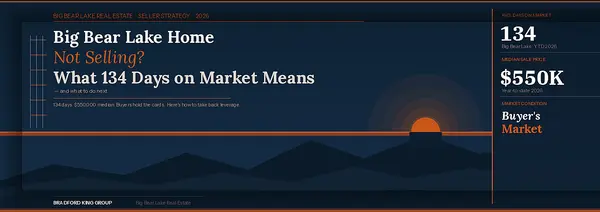
The Winter 2025-2026 Market Snapshot
The Market Competitiveness Factor
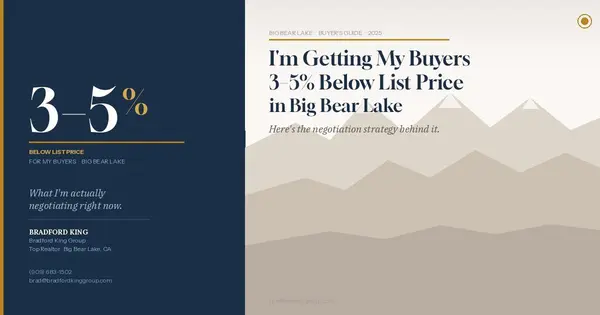
The Big Bear Lake housing market is classified as "not very competitive," with homes receiving an average of just 2 offers and typically selling for about 3% below their list price. This isn't a bidding war environment—it's a buyer's market where pricing accuracy is everything.
Winter-Specific Dynamics
On average you will see less showings across the board, but you will also tend to have more serious buyers. Buyers coming up during the cold and busy season and ones that will track through snow to see homes are more motivated.
Why Big Bear's Winter Market Is Different
The Ski Season Paradox
You might think ski season equals premium prices. The reality is more nuanced: on the first snow day of the year, demand for the next six weekends spikes immediately, but this primarily affects short-term rental income potential—not necessarily home sale prices.
Current Inventory Realities
Big Bear Lake has over 400 active listings as of this writing. More inventory means buyers have options—and that means your pricing needs to be sharp, not aspirational.
The Fatal Pricing Mistakes Winter Sellers Make
Mistake #1: Using Last Summer's Comps
Big Bear operates on two distinct seasons: Lake Season (summer) and Ski Season (winter). First quarter 2025 showed a median sale price close to where we are at now in the 590s-600k range. Winter pricing patterns differ significantly from summer peaks.
Mistake #2: Pricing for the Buyer You Hope For
During fall and winter months, sellers need to price attractively and be open to negotiations and seller concessions. The winter buyer pool is smaller but more serious—they're not browsing, they're buying. However, they're also more discerning about value.
Mistake #3: The "Room to Negotiate" Trap
Overpricing with the intention of leaving room for negotiation often leads to extended time on the market. The longer a home sits unsold, the more likely it requires price cuts that reduce its appeal and make buyers question its value.
The Right Price: A Data-Driven Formula
Step 1: Start With Accurate Comparable Sales
Don't just look at listing prices—those are hopes. Look at actual closed sales from the past 60-90 days in winter months. Your Bradford King Group agent has access to MLS data showing:
- Sold prices vs. original list prices (currently averaging 3-4% below ask)
- Days on market for comparable properties
- Price per square foot trends (currently $402 per square foot in Big Bear Lake)
Step 2: Apply the Big Bear Winter Discount Factor
For homes priced correctly from the start: Expect 90+ days on market, selling 2-4% below list price
For homes priced 5-10% above comparable sold prices: Expect 120+ days on market with multiple price reductions, ultimately selling 8-12% below original list price
Step 3: The Strategic Pricing Formula
The "Strategic Positioning Adjustment" accounts for:
- Superior condition: Add 1-3%
- Premium location (lakefront, ski access): Add 2-5%
- Recent upgrades (kitchen, bathrooms): Add 1-3%
- Turnkey rental income history: Add 2-4%
- Dated condition or deferred maintenance: Subtract 3-7%
Real-World Pricing Scenario
The Updated Mountain Cabin
Property: 3BR/2BA, 1,400 sq ft, recent updates
Comparable sold prices (last 60 days): $560K-$595K
Average sold price: $577,500
Days on market for comps: 65-85 days
Recommended list price: $595,000-$599,000
Expected sold price: $570,000-$585,000
Rationale: Price just below psychological $600K threshold to capture maximum search visibility while accounting for the typical 2-4% negotiation
What Actually Happens When You Price Too High
Week 1-2: The Honeymoon Period
- High initial interest from browsers
- Multiple showings but no offers
- Feedback: "Overpriced for condition/location"
Week 3-6: The Reality Sets In
- Showing activity drops 60-70%
- New listings at better prices steal your buyers
- You're now "old inventory"
Week 7-12: The Price Reduction Dance
- If you're not getting serious interest within 15-30 days, it's time to reassess
- First reduction of 3-5% generates minimal new interest
- Second reduction required, now 8-10% below original price
- Buyers assume something's wrong with the property
Week 13+: The Desperation Phase
- Total price reductions now 12-15% below original list
- Selling for less than you would have received with correct initial pricing
- Lost 3-4 months of carrying costs (mortgage, utilities, insurance)
The Bradford King Group Winter Pricing Strategy
Our Proven Three-Price Analysis
When you work with The Bradford King Group, we provide three strategic price points:
1. The Market Price: What the data says your home is actually worth based on closed comparable sales, current inventory, and days-on-market trends.
2. The Strategic Price: The list price designed to generate maximum buyer interest while protecting your equity—typically positioned to sell under the average days on market.
3. The Aspirational Price: What you could achieve in a perfect scenario (multiple offers, cash buyer, quick close)—but with realistic probability assessment.
Critical Pricing Questions You Must Answer
Question 1: What's Your Timeline Priority?
If you need to sell within 90 days: Price at or slightly below recent comparable sold prices. Competitive pricing in cooler months is more attractive to the smaller pool of buyers in winter.
If you can wait 120+ days: You have more flexibility to test a higher price point, but be prepared to reduce within 30 days if showing activity is weak.
Question 2: What's Your Carrying Cost Tolerance?
Calculate your monthly costs: Mortgage payment, property taxes, insurance, utilities, HOA fees, and maintenance. For a typical Big Bear home, carrying costs run $2,500-$4,500+ per month. Every extra month on the market at the wrong price costs you thousands while you wait for a buyer who will never materialize at that price.
Question 3: What's Happening With Rates and Inventory?
As of March 2025, 30-year fixed mortgage rates averaged 6.75-7.25%, while 15-year fixed rates were around 6.10%. Now we are seeing buyers getting rates in the low 6s and even high 5s. Higher rates mean buyers have less purchasing power—your $650K listing might be competing for the same buyer pool as $600K listings from six months ago.
The Psychology of Big Bear Winter Buyers
Who's Actually Buying in Big Bear This Winter?
- Local market movers upgrading or downsizing within Big Bear
- Southern California residents from Los Angeles to OC to SD and even as far as Vegas and AZ
- Investment buyers seeking rental income properties
What Winter Buyers Are Thinking
- "I'm serious enough to look in winter, so I want a deal"
- "I know the seller probably needs to move—otherwise why list in winter?"
- "I can wait for the right property at the right price"
- "I'm comparing this to 20 other similar properties online"
Special Considerations for Big Bear Property Types
Short-Term Rental Properties
Buyers of rental properties want to see documented rental income history, occupancy rates, property management arrangements, and compliance with local regulations. Capitalize on the income potential by pricing competitively to attract multiple investor offers.
Lakefront Properties
Lakefront commands premium pricing year-round, but even these properties aren't immune to winter market dynamics. You need an agent who can value a Lakefront home since comps will not get it done. There are many factors when pricing a lakefront home that many agents do not consider.
Ski-In/Ski-Out or Ski-Access Properties
Big Bear Region shows occupancy up 27% year-over-year for short-term rentals with average daily rates climbing 10%, resulting in a 39% surge in revenue per available room. Properties near ski resorts can command premium but must be priced to reflect actual market comparables, not aspirational thinking.
The Bottom Line
To Sell Your Big Bear Lake Home This Winter (Within 90 Days):
List at 97-100% of the median sold price for comparable properties from the past 60-90 days, accounting for:
- Current competing active listings
- Days on market trends (currently 73-90 days average)
- Expected 2-4% negotiation from list price
- Seasonal buyer pool reduction
- Property condition and unique features
This means: If comparable homes sold for $575,000 average over the past 60 days, your strategic list price is likely $560,000-$580,000 to generate activity and offers in the $545,000-$565,000 range.
Get a Free Strategic Pricing Analysis
The Big Bear Lake winter market rewards accurate pricing and punishes wishful thinking. Every week you wait at the wrong price costs you money in carrying costs and reduces your ultimate sale price.
We'll provide comprehensive comparative market analysis, three strategic pricing scenarios with expected outcomes, current competing listings analysis, customized marketing strategy, and timeline projections.
Call us at (909)683-1502 or email Team@bradfordkinggroup.com
Categories
Recent Posts